
Washtenaw County Court Records After Arrest
A jail booking in Washtenaw County does not create the final court charge list by itself. The arresting agency sends reports to the correct charging office. The Washtenaw County Prosecuting Attorney reviews many criminal reports and decides what charges to authorize. Some city matters may route through a city attorney. Once a complaint, information, or other charging paper is filed, the court record begins to show the public case path after the arrest. That record can include the case number, court, judge, filed date, charge level, bond orders, hearing dates, attorney information, disposition, and sentencing entries when the case reaches that point.
The jail side still matters. Washtenaw County did not have an official public jail roster in the reviewed WCSO pages, so current custody checks usually start with the inmate information line or records request process. Booking details and custody status belong with jail inmate records, while booking-photo questions fit the jail mugshots page. Court records after a jail arrest answer a narrower question: what charges were filed, where the case is pending, and whether the charge remains pending, was changed, was dismissed, or became a conviction.
The main local court systems are split by jurisdiction. District courts handle many early steps, including arraignments, misdemeanors, preliminary exams for felony cases, and traffic or criminal matters. The 14A District Court serves much of Washtenaw County except Ann Arbor and Ypsilanti Township. Ann Arbor has the 15th District Court, and Ypsilanti Township uses the 14B District Court. The 22nd Circuit Court is the Washtenaw Trial Court civil and criminal division of general jurisdiction, and felony cases can move there after bindover or filing of an information.
Find Washtenaw County Court Records
Start with the Washtenaw Trial Court Name Search when the case may be in the county trial court system. The official page states that the site contains Washtenaw County Trial Court public case records. It also warns that public case documents are not available online and must be obtained for a fee. The direct PublicAccess portal offers criminal case records, civil, family, and probate case records, plus a court calendar. Its notice says data is current through the end of the previous business day.
The MiCOURT case search is the broader Michigan court search path. Washtenaw 14A online resources link users to MiCOURT, and Ann Arbor's 15th District Court case-search page points to the state-hosted public records search. MiCOURT terms state that online information is informational only, does not replace the official court record, and cannot be used as a bulk data download source. If a new arrest does not appear, the charge may not have been filed yet, the case may be in another local district court, or the record may require direct clerk contact.
- Confirm the person was booked or is in custody through Washtenaw County jail information when current custody is the first question.
- Identify the arresting agency and likely court. Ann Arbor, Ypsilanti Township, and other county jurisdictions may route to different district courts.
- Search by defendant name, case number, citation number, or filing date in the Washtenaw Trial Court portal or MiCOURT.
- Open the case index and compare each charge, charge level, hearing, bond entry, and case status against the jail or police wording.
- Request full documents from the court clerk when the online docket shows a case but not the complaint, filing, certified copy, or protected document.
The 14A District Court online resources page also links case lookup, docket tools for 14A-1 through 14A-4, online plea options, and probation reporting. Those district-court tools are useful when the charge followed a local arrest but has not moved to circuit court. For statewide criminal history or public-record limits, Michigan FOIA and court rules still matter, but the originating court remains the office to contact for the official case record.
The Washtenaw Trial Court name-search page is an official source for local public case records. The screenshot below is from the county court page and shows why a local court search is separate from jail custody lookup.
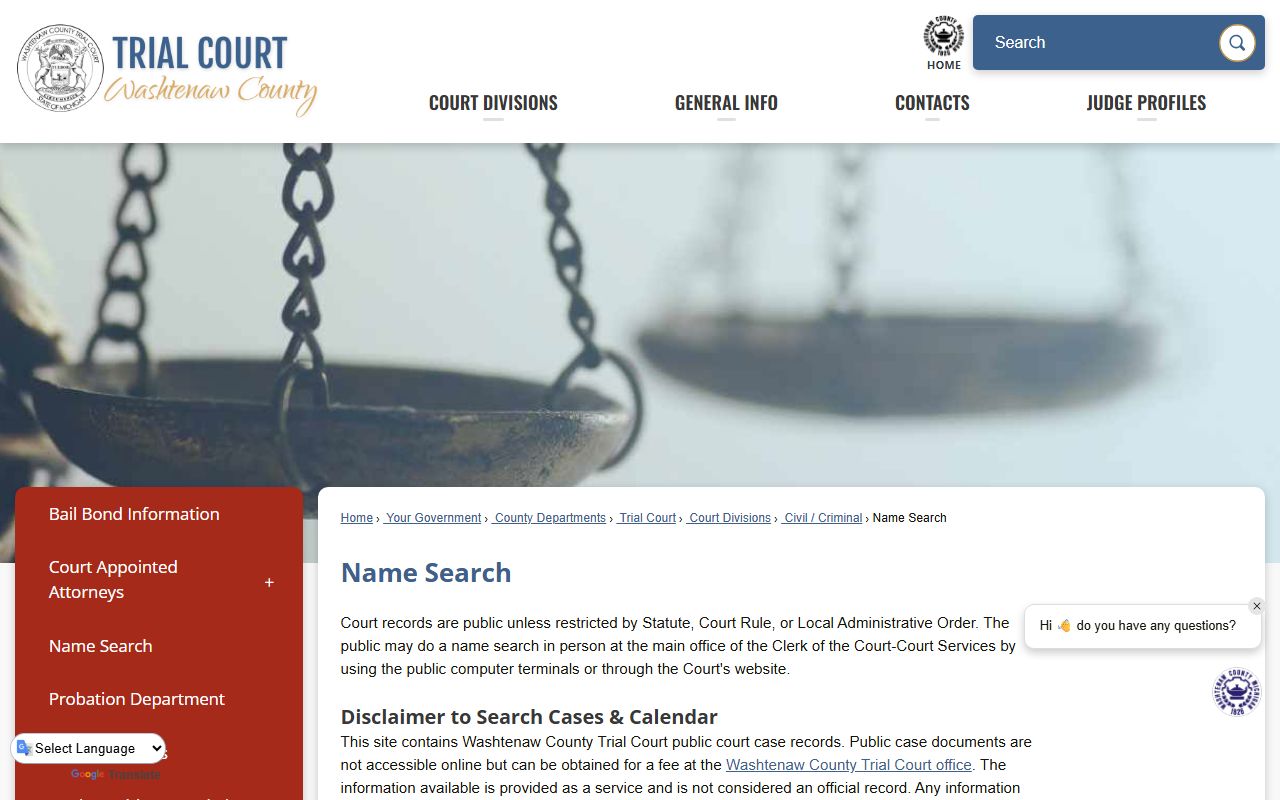
Use that county search when the arrest has become a filed Washtenaw Trial Court case, then move to MiCOURT or the district court tools if the local index does not show the case.
Washtenaw Court Search Fields
The Washtenaw Trial Court PublicAccess portal and MiCOURT provide several ways to search court records after an arrest. The best field depends on what is known. A case number is precise, but most people start with a name. Soundex can help with spelling variations. Date filed can help when the arrest date is known but the case number is not. Some fields are conditional, meaning they appear or become useful only after a search type is selected.
| Field Label | Type | Required | Use Notes |
|---|---|---|---|
| CAPTCHA | Text | Yes | Required before searching the Washtenaw Trial Court PublicAccess portal. |
| Search By | Dropdown | Yes | Case, defendant, citation, attorney, or date filed. |
| Exact Name | Checkbox | Optional | Use when the spelling is known and false matches are a problem. |
| Use Soundex | Checkbox | Optional | Helps locate similar-sounding last, first, or middle names. |
| Case Number or Citation Number | Text | Conditional | Best for a known court case, citation, or cross-reference number. |
| Last, First, Middle Name | Text | Conditional | Name searches may require last and first name in party mode. |
| Date of Birth or Driver's License | Text | Optional | Useful for distinguishing people with similar names. |
| Case Status Type | Radio | Optional | All, open, or closed case status. |
| Date Filed Range | Date or text | Conditional | Searches cases filed on or after, or on or before, selected dates. |
| Case Types | Multi-select | Optional | If none are selected, portal instructions say all case types are searched. |
MiCOURT adds court selection, case year, case number, case type, business name, birth date or birth year, and professional number fields. The court of record should be contacted when a search result conflicts with a clerk notice or when a certified record is needed.
Charges Filed After Arrest
Charges can change between the jail booking screen and the court case. The booking language may reflect the arresting officer's initial reason for custody. The court language reflects what the prosecutor, city attorney, or grand-jury process files. In Washtenaw County, Prosecutor Eli Savit's office reviews criminal reports for many county cases and authorizes charges when the evidence and law support filing. That filing is the point where a court record after a jail arrest becomes the controlling public case record.
| Document | Who Files It | Common Use | What It Means |
|---|---|---|---|
| Complaint | Prosecutor, city attorney, or authorized officer process | Misdemeanors and many early felony filings | Starts the criminal case and lists the accusation placed before the court. |
| Information | Prosecutor | Felony cases after bindover or waiver | Formal felony charging document used after the case moves beyond the first district-court stage. |
| Indictment | Grand jury process | Serious or specially investigated felony matters | Charges authorized through a grand-jury route rather than the standard complaint path. |
Michigan court records may show amended charges, reduced charges, dismissals, pleas, trial verdicts, and sentencing entries. A person can be arrested on one offense label and later charged with a different offense. That is not always an error. It often means the prosecutor reviewed the police report and selected a charge that better fits the proof, statute, or plea posture.
Washtenaw Charge Status Terms
Charge status is one of the most useful parts of a court record after a jail arrest. It shows whether the accusation is still active and whether the court has reached a result. The same case can have several charges with different outcomes. One count may be dismissed while another remains pending. A felony may be reduced. A misdemeanor may be resolved by plea. Read each count on its own line when the portal shows a charge list.
| Status | Meaning in a Court Record | Reader Caution |
|---|---|---|
| Pending | The charge is filed and not yet resolved. | Pending is not a conviction. |
| Amended | The charge wording, statute, level, or count has been changed. | Compare the amended count to earlier booking language. |
| Reduced | The filed offense is lowered to a lesser offense or lower charge level. | The final disposition may not match the arrest label. |
| Dismissed | The court or prosecutor ended that count without conviction. | Other counts in the same case may remain active. |
| Nolle Prosequi | The prosecutor declines to continue that charge. | The docket should be checked for any related refiling or companion case. |
| Convicted | A guilty plea, no-contest plea accepted as allowed, or trial verdict resulted in conviction. | Sentencing and set-aside eligibility are separate questions. |
Online records are not the same as certified records. Washtenaw's PublicAccess notice says some case types are not available online and that public case documents are not accessible through the web portal. For a certified judgment, complaint, order, or full docket, use the court clerk's process rather than relying only on a screen result.
Bond After Washtenaw Arrest
Bond appears in court records because release conditions are set by a judicial officer, even when the person is held at the Washtenaw County Jail. The county's official Bonding Information page gives one clear local rule: when a 10% bond is posted, the court retains 10% of the posted amount. The posted bond is released to the bonder when the case ends, or earlier if a judge orders it. The research did not locate a complete official table for payment methods, hours, card fees, or kiosk rules, so those details should be confirmed with the jail or court before anyone travels to pay.
| Bond Type | How It Works | Washtenaw Note |
|---|---|---|
| Personal recognizance | Release based on a promise to appear and follow conditions. | Set by the court, not paid through a jail money account. |
| 10% bond | A percentage of the full bond amount is posted. | Washtenaw states the court retains 10% of the posted amount. |
| Cash bond | Money is posted through the court or jail process. | Accepted payment channels must be verified before arrival. |
| Surety bond | An outside surety or bail agent backs the bond where allowed. | Eligibility depends on the case and court order. |
| No-bond hold | Release is barred or another legal hold keeps the person in custody. | May involve another county, probation, parole, federal, ICE, or a court order. |
Bond status should be checked against both custody information and the court docket. A court record may show the bond amount, bond ordered date, judge setting bond, bond posted date, release from jail on bond, failure to appear, and bond forfeiture entries. A detainer means another agency has a hold. A remand means a court has ordered the person held in custody. Those terms can explain why a person remains in jail even when one case appears to have a bond.
Warrants Before Court Records
No official WCSO public active-warrant search was located in the reviewed sheriff pages. That finding should be read narrowly. It means no official public sheriff warrant database was found, not that a warrant cannot exist. Warrant questions should be checked with the court of jurisdiction, the sheriff's office, and MiCOURT or court docket resources. A bench warrant may appear after a missed court date, probation violation, unpaid fines or costs, or other noncompliance. An arrest warrant authorizes custody. A search warrant is different and is not an inmate lookup record.
Use official numbers and known court portals for warrant questions. WCSO general routing is through 734-971-8400. If the warrant already led to booking, the jail inmate information line can help confirm custody. The safest route for resolving a bench warrant is direct contact with the issuing court or counsel. Be cautious with callers who claim that money must be paid at once for a warrant or missed jury duty. Independent verification through official court or sheriff contacts is the practical check.
Important: Do not pay a warrant demand from an incoming caller unless the court or sheriff verifies it through an official number.
Charges Versus Convictions
A court record after a jail arrest may be public before any conviction exists. That is why charge status must be read carefully. A charge is an accusation filed in court. A conviction is a later result after a guilty plea, accepted plea, or trial verdict. Public records can contain both kinds of entries, but they do not mean the same thing for employment, housing, licensing, or personal decisions.
| Point | Charge | Conviction |
|---|---|---|
| Stage | Accusation after police and prosecutor review. | Case result after plea, verdict, or other final finding. |
| Proof Level | Based on probable cause and filing standards. | Requires proof beyond a reasonable doubt or a valid plea. |
| Record Meaning | Shows what was alleged in court. | Shows legal responsibility for the offense. |
| Can Change | May be amended, reduced, dismissed, or declined. | May later be appealed, set aside, or affected by court relief. |
Sealed Versus Expunged Records
Michigan public access is broad, but it is not unlimited. Michigan FOIA, MCL 15.231, states the public policy favoring access to information about public bodies, subject to exemptions. Law-enforcement, privacy, juvenile, sealed, expunged, and safety-related limits can restrict release. Michigan's set-aside framework, MCL 780.621 et seq., affects public access to eligible criminal history after relief is granted.
| Point | Sealed | Expunged or Set Aside |
|---|---|---|
| Public View | Hidden from ordinary public access by rule or court order. | Treated as removed from ordinary public criminal history access after legal relief. |
| Agency Access | Some courts or law-enforcement agencies may retain limited access. | Access can remain for specific government or justice-system purposes. |
| Eligibility | Depends on case type, order, juvenile status, or protected-record rule. | Depends on Michigan set-aside law, offense type, waiting period, and court action. |
| Practical Step | Ask the court clerk how the record is restricted. | Use the court process and confirm the update with the originating agencies. |
Michigan biometric arrest data law also matters when charges are dismissed before trial. MCL 28.243 governs collection, forwarding, and removal or destruction processes for some arrest biometric records. That does not mean every web mention disappears at once. It means the official court and agency record should be checked first when dismissal, sealing, or set-aside relief is involved.
Restricted Washtenaw Court Records
Some Washtenaw County court records after arrest are not fully visible online. The PublicAccess portal notice says PPO, NA, and DL case types are not available on the site and must be accessed at the court. Juvenile matters, protected personal information, sealed charges, expunged records, and records tied to ongoing investigations may be withheld or redacted. Public docket information may be available while full documents remain behind clerk procedures and fees.
The Washtenaw County Sheriff's Records Request route is the public-records fallback for booking-related materials, incident reports, local jail checks, and report copies. FOIA does not override every exemption. The court, sheriff, prosecutor, MDOC, BOP, and ICE each control different records. For court records after a jail arrest, the official court record controls the filed case, while the sheriff controls jail and booking material.
Washtenaw's sheriff records request page is the official route for sheriff-held records when a court docket does not answer a booking or report-copy question.
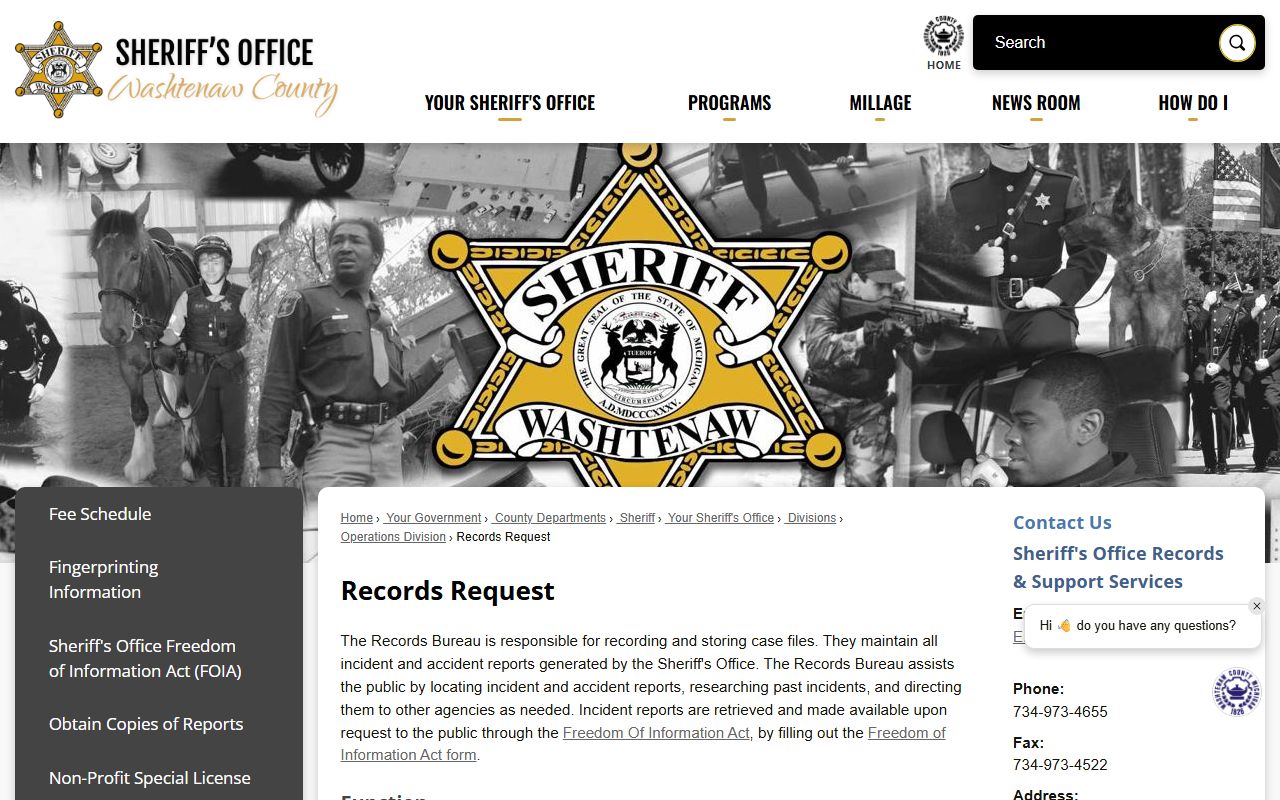
Use that records channel for sheriff-held material, and use the clerk or court portal for the filed criminal case.
Washtenaw Prosecutor Records Role
Michigan uses the title Prosecuting Attorney, not District Attorney. The Washtenaw County Prosecuting Attorney's Office is led by Prosecutor Eli Savit. The office lists phone 734-222-6620 and provides links for leadership, divisions, victim and witness services, child support services, internships, and employment information. In the arrest-to-court pathway, the office is important because a booking charge is not final merely because the person was taken to jail.
The prosecutor's review can lead to authorization, amendment, reduction, dismissal, or no charge. Victim and witness services can help eligible parties with case status, referrals, victim compensation information, and court procedure questions. Public users still use the court portal and clerk for official court records. Prosecutor pages explain office function and services, but the docket is the case record that tracks each filed charge.
Important: This site is not a consumer reporting agency, and court or jail data cannot be used for FCRA-covered screening decisions.
Public Record Search
Sponsored Results